
The History of Pound Ridge
Adapted from © Lisl Steiner
How It All Began
Originally home to members of the Wappinger Confederacy, Pound Ridge takes its name from an indigenous “pound,” or enclosure for game, on one of the area’s many “ridges.” Native Americans in the area led lives of rich and complex social and cultural traditions for generations. European colonial expansion began to affect the area in the 1640s, when English Captain Nathaniel Turner purchased the land from local Native Americans, and when Dutch forces expanded Keift’s War into the region. European colonists first settled Pound Ridge in the early 18th century, and it was officially incorporated in 1788. For the last 250 years, there has been much controversy over the spelling of “Pound Ridge” or “Poundridge.” In 1948, the Town Board declared the name to be two words: “Pound Ridge.”

Revolutionary War Time
During the Revolution, on July 2, 1779, Pound Ridge was the scene of the dramatic raid led by the British Lt. Col. Banastre Tarleton. Tarleton overwhelmed the local militia commanded by Major Ebenezer Lockwood and the regiment of Continental Light Dragoons led by Lt. Col. Elisha Shelton stationed in the Hamlet area. Tarleton got lost while trying to reach Pound Ridge, giving the Americans more time to prepare. However, with better than a 2-to-1 advantage, Tarleton ("The Butcher") conquered, plundered, and burned much of the town. American reinforcements arrived, fought back, and Tarleton retreated.
Rebuilding and Trade
After the war, Pound Ridge continued to flourish. Saw mills, grist mills, blacksmith shops, and general stores were built. By 1850, the population reached 1,486. Although a dairy farming community, Pound Ridge became known for hat- and shoe-making. However, its most famous industry was basketmaking (first developed by Native Americans). In fact, the Scotts Corners area of Pound Ridge was commonly referred to as "Basket Town," and many of the sturdy baskets were used by the oyster fishermen on Long Island Sound.

The Leatherman
The Leatherman
The Leatherman was a gentle hermit and interesting character who roamed the area for 30 years in the latter half of the 1800s. His true story is shrouded in mystery, but he was a large man who loved leather and always wore his handmade patchwork leather outfit (with a leather hat and leather clogs). He lived in caves or rock shelters and accepted food or leather. He didn't speak but mumbled, and his headstone identifies him as Jules Bourglay of Lyons, France.

Fred Bennett Scofield (1866-1950), basket maker
Early 20th Century Economy
By the early 20th century, farming had declined, as had the cottage industries. The railroads in Westchester, which opened up markets and brought in new people, bypassed Pound Ridge. By 1920, the population dwindled to 515. Then, during the 1930s, things changed. Hiram Halle, an inventor and businessman, came to Pound Ridge from New York City and began renovating and reconstructing houses.
Hiram J. Halle (1867-1944)
Hiram Halle and the community
Hiram Halle is probably Pound Ridge's biggest benefactor. A successful businessman and inventor, he helped found the University in Exile at the New School for Social Research, which rescued Jewish scholars, academics, and artists from Europe during the Holocaust. Halle moved to Pound Ridge in 1929. He hoped to enhance the community through his philanthropy and his work restoring homes. Benny Goodman was another resident, and he even composed a melody entitled "Pound Ridge". By the 1940's, Pound Ridge's population had risen to almost 800, and it continued to grow slowly and steadily, reaching 4,000 in 1980 and 4,550 in 1990.
Early view of Stone Hill Road
Presbyterian Lecture Room c. 1800's, now our museum
Preservation
Interest in the preservation of Pound Ridge's architectural heritage has also been maintained throughout the years. These older landmarks and homes are an integral part of the town's character and provide the community with a shared "pride of place". The current population of the town of Pound Ridge, NY, is 5,082 (2020 US Census), with most residents living in single-family dwellings in 2- or 3-acre minimum-zoning districts. In addition, there are deer galore, swans, ducks and geese, foxes and coyotes, bobcats, raccoons, otters, squirrels, chipmunks, frogs, crickets, etc.
Midcentury Modern
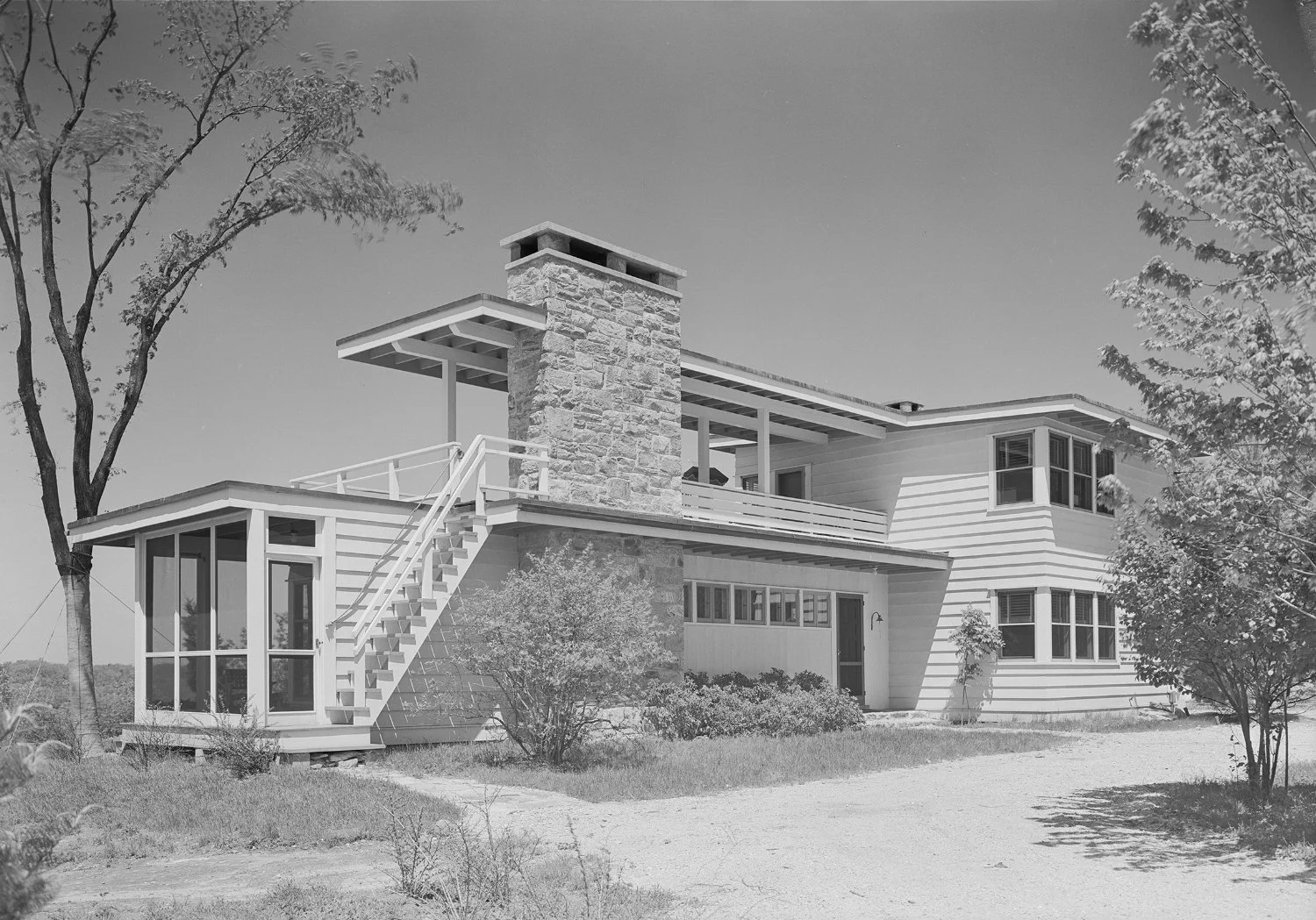
Pound Ridge’s modern architectural story began in the late 1930s. It accelerated through the 1950s and 1960s, when architects, artists, and families from New York brought new design ideas into the town’s wooded landscape. Early and mid-century houses by architects including John C.B. Moore and David Henken introduced flat or low-pitched roofs, broad walls of glass, open plans, and strong indoor-outdoor connections.
That tradition continued and evolved in later decades through the work of Vuko Tashkovich, who developed a more sculptural, highly individual architectural language while keeping a core modern principle at its center: designing homes in conversation with the land, light, and surrounding trees.
Midcentury Modern houses in Pound Ridge emphasized low or gently pitched roofs, large expanses of glass, open and efficient floor plans, deep overhangs for seasonal light control, and a strong visual connection to the land. Rather than treating buildings as isolated objects, many designs were carefully integrated with rocks, trees, and natural grade. From custom family projects to architect-designed residences linked to major modernist circles, Pound Ridge’s mid-century homes helped define the town’s character and continue to shape its identity today.
Pound Ridge Today
Located in the northeast section of Westchester County, the municipality of Pound Ridge borders both New York and Connecticut. Pound Ridge is adjacent to the Connecticut towns of New Canaan and Stamford. On the New York side, Pound Ridge borders Bedford and the more rural town of South Salem. A rugged landscape, rock outcroppings, and rugged cliffs characterize Pound Ridge. "Nowhere in the town's 23 square miles is there even a traffic light."
In many parts of Pound Ridge, the rugged landscape seems to have been only gently altered by humans since the glaciers receded. In contrast to some of its neighbors, the town, Westchester's smallest in population density, has marked its topography over the years not with highways and malls but rather with stone walls and narrow country roads that wind past meandering brooks, stone outcroppings, and densely wooded hills. Pound Ridge boasts many large tracts of conserved and undeveloped land. Between the 4,315-acre Ward Pound Ridge Reservation, the efforts of the Westchester Land Trust and the Pound Ridge Land Conservancy, combined with sensitive town planning, much of Pound Ridge will remain "forever wild."
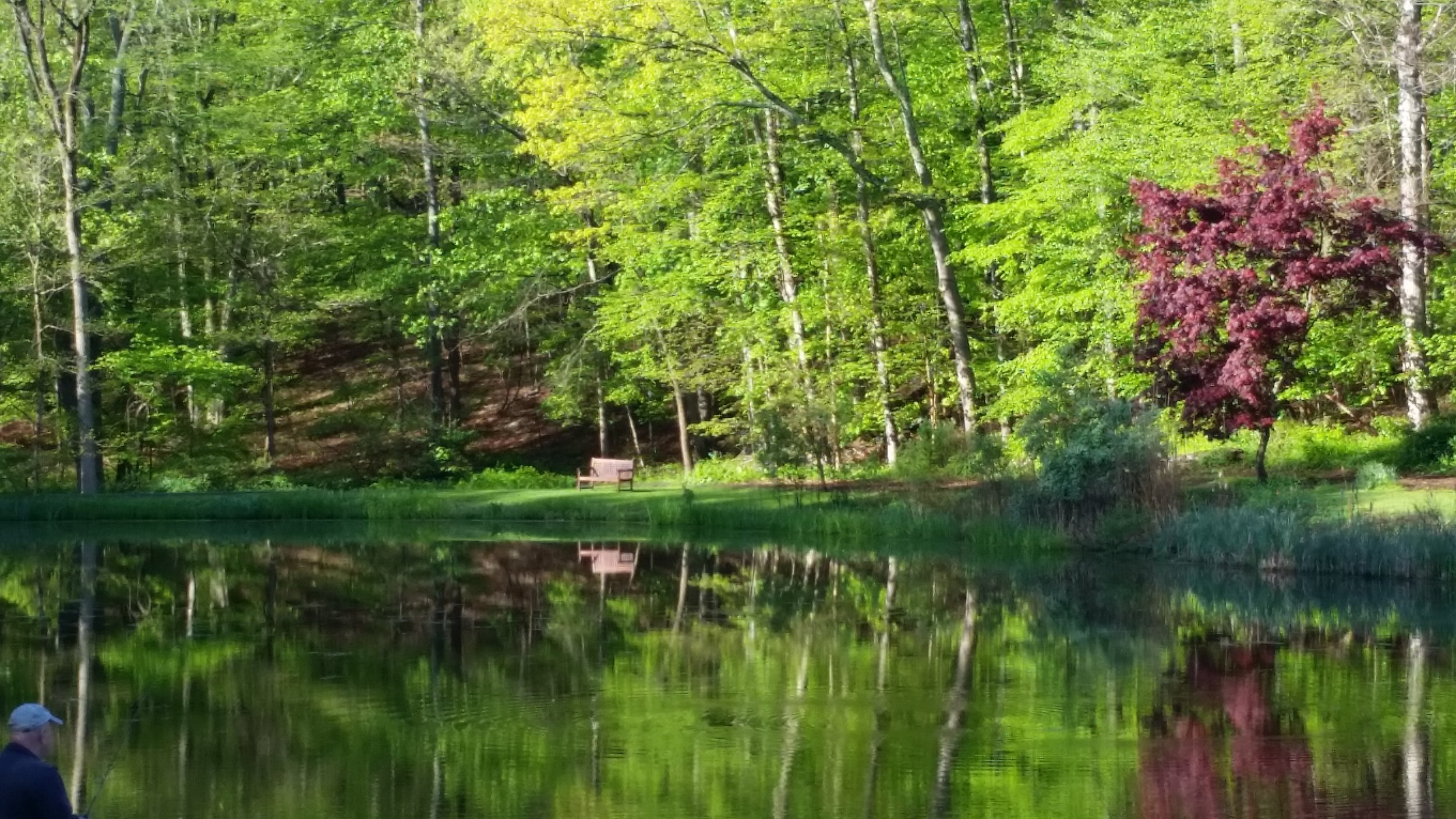
Pound Ridge Park pond